The Neurodiplomacy Project explores how professional training, symbolic literacy, and institutional roles shape the way people perceive cultural heritage and diplomatic space. Conducted at the American Embassy in Rome (Villa Ludovisi), the study combines neuroscience, AI-based analysis, and cultural heritage research to examine how diplomats and non-diplomatic observers engage with artworks and representational environments. The project demonstrates that perception is not universal: it is learned, structured, and measurable. By making perception visible through data, Neurodiplomacy opens new pathways for understanding cultural diplomacy, heritage interpretation, and the design of symbolic spaces.
THE NEURODIPLOMACY PROJECT
Perception, Cognition, and Cultural Diplomacy in Practice
U.S. Embassy Rome
2025
WHAT IS NEURODIPLOMACY?
Neurodiplomacy is an interdisciplinary research framework that integrates neuroscience, perceptual analysis, and cultural heritage studies to examine how diplomacy operates at the level of attention, cognition, and emotion. Diplomatic practice is not limited to negotiation or policy; it also involves sustained exposure to symbolic environments—embassies, artworks, architecture, and ritualized spaces—that convey power, continuity, and national identity. Neurodiplomacy asks how these environments are cognitively processed and how professional training reshapes the act of seeing itself.
The central premise is that diplomats develop a distinct perceptual mode through years of exposure to protocol, representation, and institutional symbolism. This mode can be measured and compared to that of non-diplomatic audiences, revealing how meaning is extracted, prioritized, and stabilized in cultural and political contexts.
Study Design and Methods
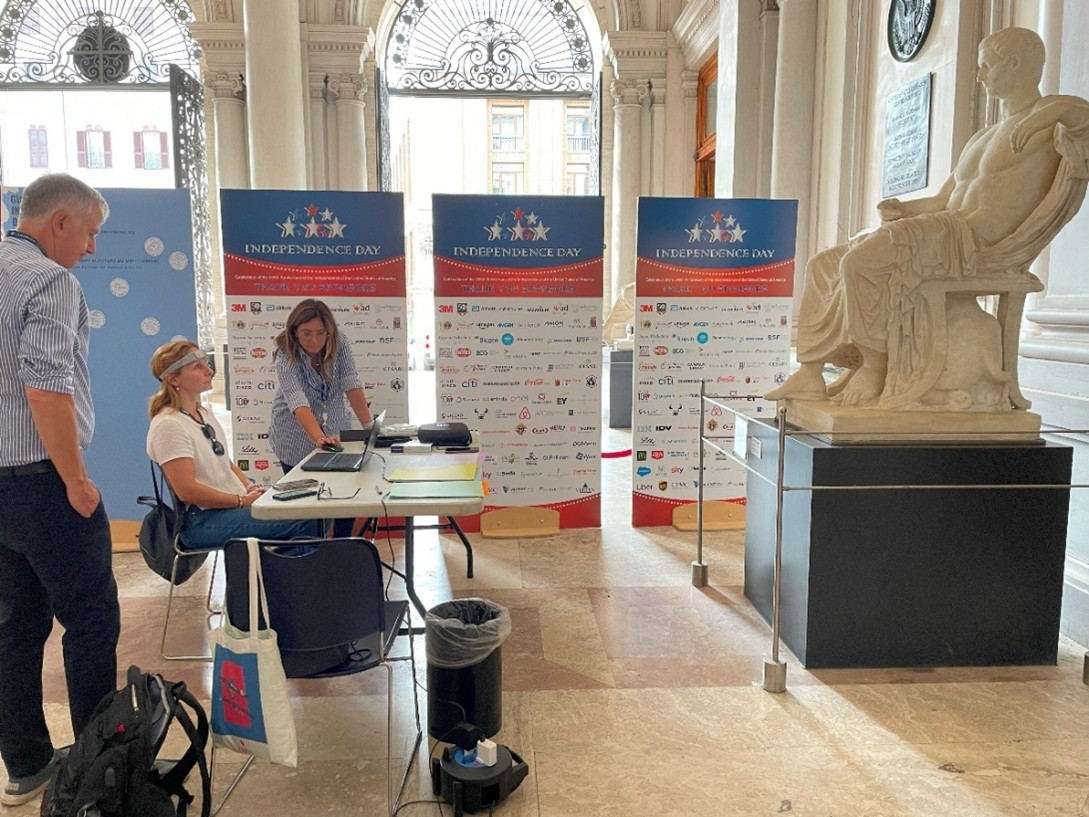
The Rome case study involved 44 participants, divided equally between professional diplomats and external observers. Two complementary experimental settings were used. In the first, participants observed a Roman statue under controlled conditions while wearing a portable functional near-infrared spectroscopy (fNIRS) headband to capture cortical activity. Facial expressions were simultaneously recorded and analyzed using AI-based facial action unit detection. A short eyes-closed baseline was followed by open-eye observation, allowing comparison between resting and active perception.
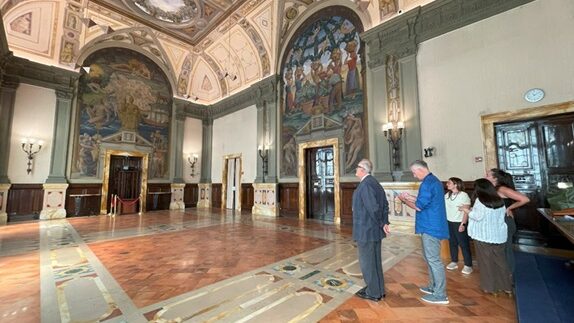
In the second setting, participants explored the Young Conference Room at Villa Ludovisi while wearing mobile eye-tracking glasses. This allowed researchers to record gaze trajectories, fixation density, and attentional clustering in a real diplomatic environment. Together, these methods captured neural, facial, and visual data, enabling a multimodal analysis of perception “in the wild,” rather than in artificial laboratory conditions.
Key Findings: The Protocol Effect
One of the clearest outcomes of the study is the identification of what can be termed a protocol effect. Diplomatic participants exhibit perceptual patterns that differ systematically from those of external observers. Neural data suggest a more reflective, top-down mode of engagement, consistent with symbolic interpretation rather than purely sensory or aesthetic response. Facial analysis reveals an initial phase of controlled tension or concentration, followed by subtle markers of recognition and contextual understanding.
External observers, by contrast, tend to show flatter neural and facial profiles, consistent with exploratory or aesthetic viewing. These differences do not indicate greater or lesser sensitivity, but rather distinct perceptual strategies shaped by professional formation. Diplomats are trained readers of symbolic space.
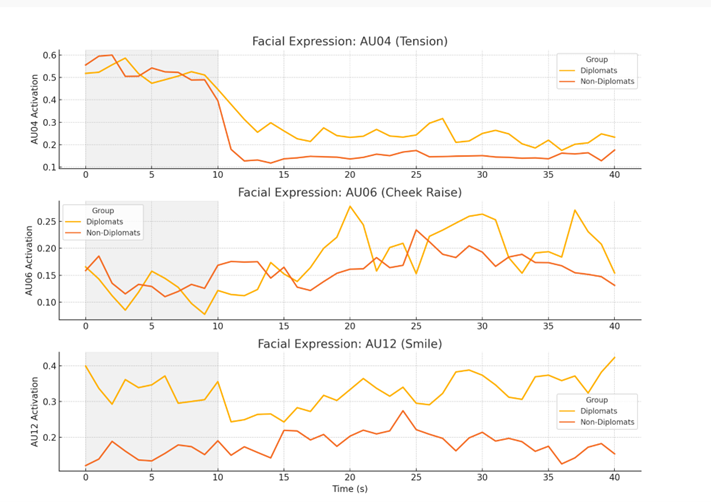
Time-series plots show mean activation levels of AU04 (brow tension), AU06 (cheek raise), and AU12 (smile) over a 40-second observation period for diplomats (orange) and non-diplomats (red). Diplomats exhibit higher initial AU04 activation, indicating greater early cognitive tension, followed by a more gradual stabilization. In contrast, non-diplomats show a sharper reduction in tension after the initial phase. Across AU06 and AU12, diplomats display consistently higher activation, suggesting more sustained engagement and affective modulation during observation. Shaded areas mark the initial orientation phase of the task. AU are specific areas of the face that influence human expression.
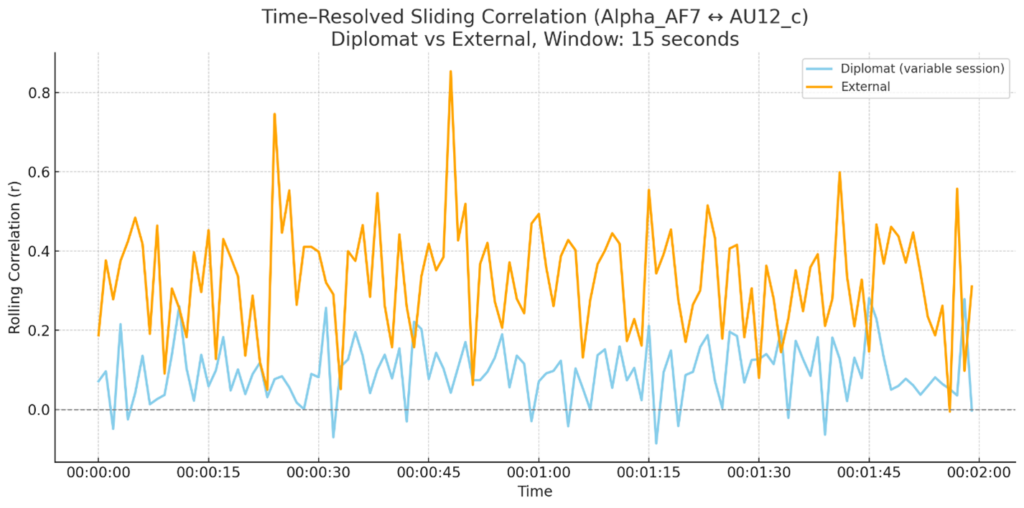
The plot shows sliding-window correlations (15‑s window) between frontal alpha activity (Alpha_AF7) and facial AU12 (smile) for diplomats (blue) and external observers (orange). External participants exhibit consistently higher and more volatile positive correlations, indicating a tighter coupling between alpha modulation and overt affective expression. Diplomats show weaker, more regulated correlations centered near zero, suggesting a decoupling between neural relaxation states and facial expressivity. The dashed line marks zero correlation, highlighting differential neuro-affective integration across groups.

Alpha-band modulation during heritage perception reveals oscillation between sensory engagement and internal interpretive states, tightly coupled with embodied actions. In simple terms, this means that when people encounter cultural heritage, their brains continuously shift between looking, feeling, and thinking, with the body actively participating in how meaning is formed.
Gaze, Space, and Symbolic Hierarchies
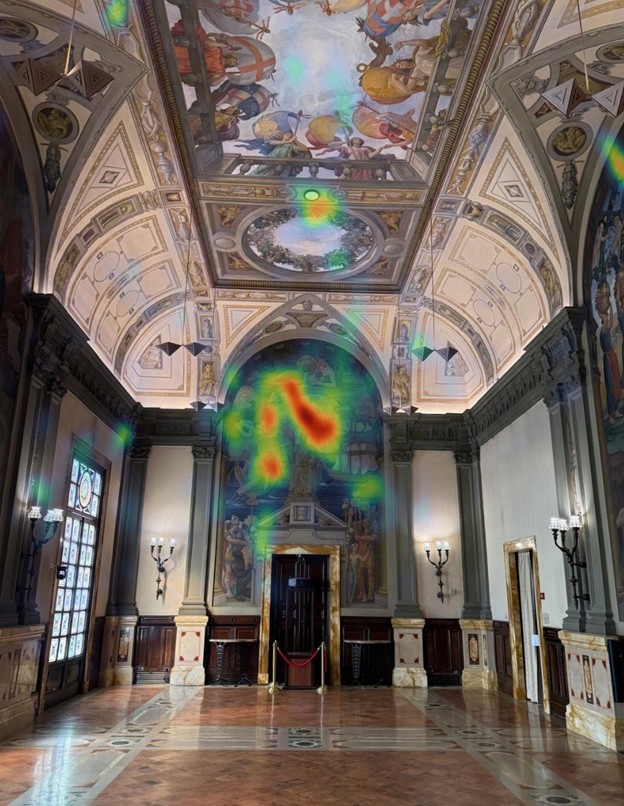
Eye-tracking data from the Young Conference Room reveal that diplomats do not scan space randomly. Their gaze is organized along vertical and hierarchical axes, repeatedly returning to emblematic elements, allegorical figures, and architectural focal points associated with institutional authority. Attention clusters around features that encode power, continuity, and representational meaning.
External observers distribute their gaze more evenly across the room, exploring decorative details, peripheral zones, and material features with less recurrence to symbolic anchors. This contrast highlights how the same environment can function either as a narrative instrument or as a visually complex setting, depending on the observer’s cognitive training.
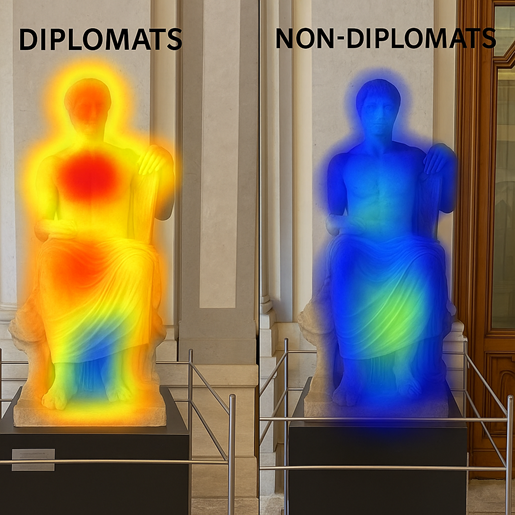
- Left: Diplomats — strong, focused engagement (warm colors radiate especially from the chest, head, and gesture hand).
- Right: Non-Diplomats — diffuse, cooler, and much less intense aura, especially in the upper body and head.
This visually demonstrates how the Roman statue is cognitively assimilated as a diplomatic symbol by diplomats, while non-diplomats perceive it as a neutral object.
Heatmaps represent normalized gaze density during free exploration of the space. The diplomat condition (B) shows a concentrated, vertically oriented focus on the central mural and its symbolic apex, with limited dispersion to peripheral architectural elements. The non-diplomat condition (right) displays broader and more diffuse gaze distribution, extending across the ceiling, lateral arches, windows, and decorative details. Color scale indicates relative fixation intensity from low (blue/green) to high (red).
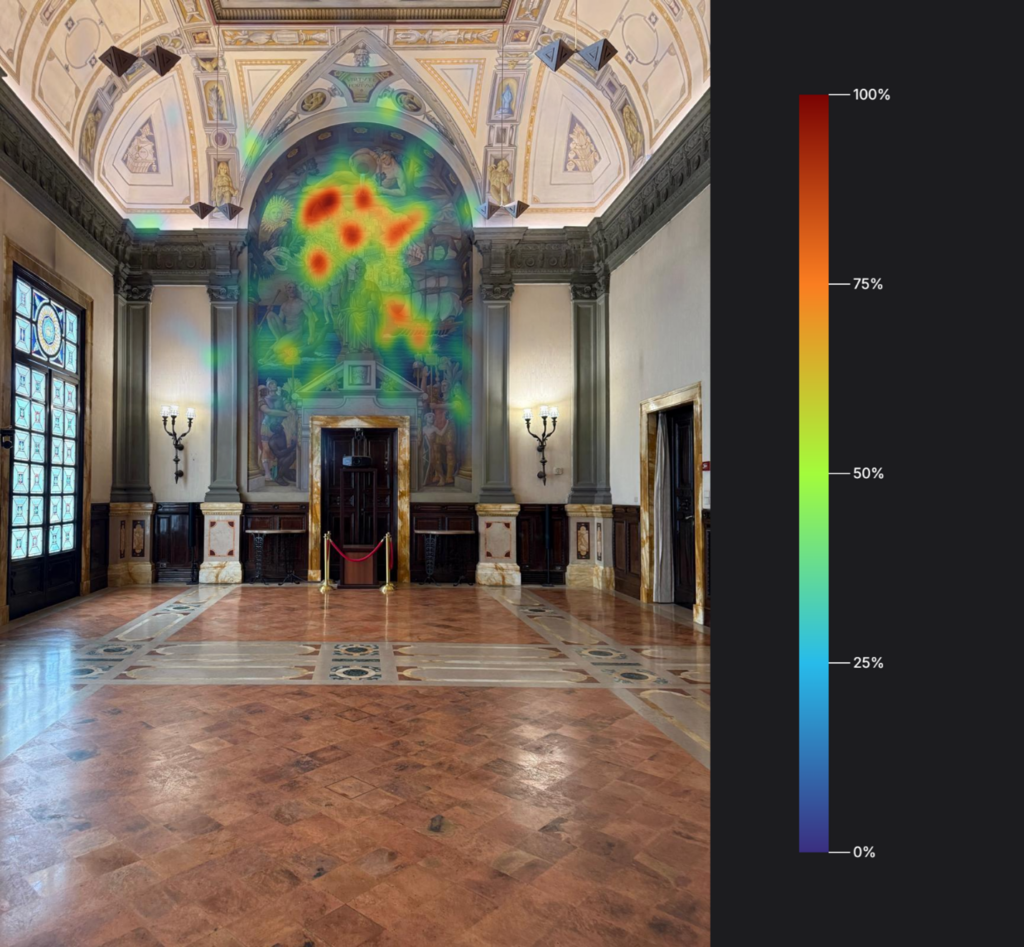
Diplomats exhibit a more selective and hierarchically organized viewing strategy, privileging central symbolic content and maintaining sustained attention on representational focal points. Non-diplomats (A), by contrast, adopt an exploratory scanning pattern that samples a wider range of architectural and decorative features. This contrast supports the presence of a “protocolized” mode of perception among diplomats, in which attention is guided by symbolic relevance and institutional literacy rather than by spatial curiosity alone.
Cultural Diplomacy as a Perceptual Practice
These findings suggest that cultural diplomacy operates not only through content or messaging, but through perception itself. Diplomatic spaces are effective when their symbolic logic aligns with the perceptual scripts of their intended audience. For trained observers, such environments reinforce institutional narratives and authority. For untrained audiences, meaning may remain diffuse or primarily aesthetic.
Understanding these dynamics has practical implications for the design of embassies, exhibition spaces, and cultural programs. Rather than assuming universal impact, institutions can use perceptual data to evaluate how different audiences actually experience symbolic environments.
AI, Reproducibility, and Interpretation
Artificial intelligence plays a central role in the Neurodiplomacy workflow. AI-enabled pipelines were used to synchronize neural, facial, and eye-tracking data, detect patterns, and visualize results. Importantly, AI is employed here not as a black box, but as an interpretive aid that enhances transparency and reproducibility. Code-based workflows allow analyses to be re-run, parameters to be adjusted, and alternative interpretations to be tested.
This approach demonstrates how AI can support humanities research by making complex perceptual phenomena legible and comparable, without reducing interpretation to automated outputs.
Implications and Future Directions
The Rome study serves as a proof of concept for a broader Neurodiplomacy research agenda. Future work will extend this framework to additional embassies, cultural institutions, and professional communities, enabling comparative analysis across geopolitical and cultural contexts. Larger samples, longitudinal studies, and experiments during live diplomatic events will further refine the model.
More broadly, Neurodiplomacy points toward a new science of audience for cultural heritage and diplomacy—one grounded in measurable attention, cognition, and affect. By understanding how people actually perceive symbolic environments, institutions can design spaces and programs that communicate more effectively, ethically, and inclusively.
The Neurodiplomacy Project demonstrates that perception is not neutral, but shaped by training, context, and role. By combining neuroscience, AI, and cultural heritage studies, the project reveals how diplomacy operates at the level of attention and cognition. Rather than replacing interpretation, this approach enriches it, offering new tools to understand how meaning is produced, stabilized, and transmitted through cultural and diplomatic space.