Collections
Josep Maria Sert Mural Conservation and Relocation
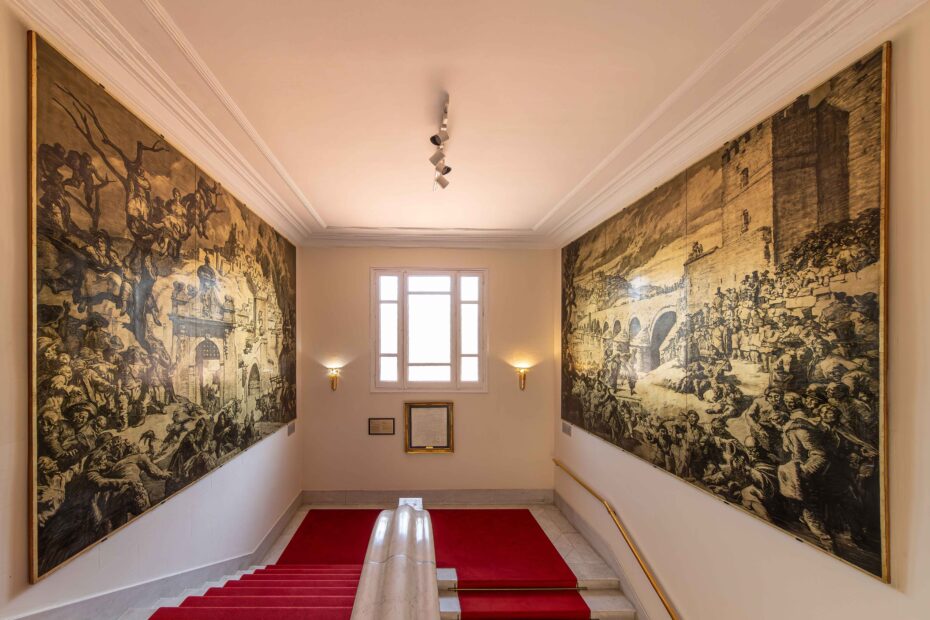
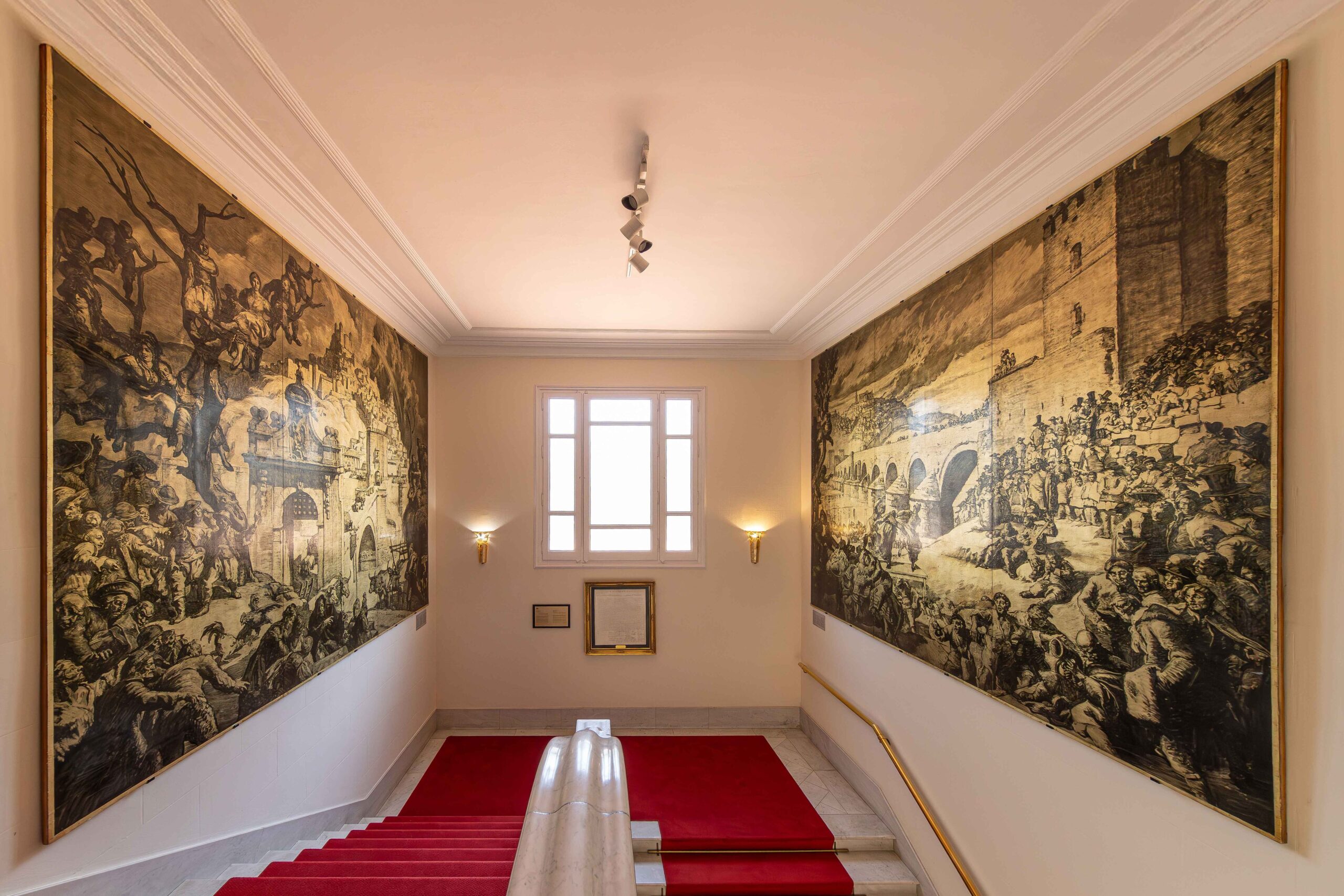
Two monumental murals by the Catalan painter Josep Maria Sert (1874–1945) now hang prominently in the stair hall of the US Consulate General in Barcelona. These murals, depicting iconic views of the Spanish cities of Toledo and Cordoba, are executed in Sert’s signature grisaille style, monochrome greyscale on a metallic gold background. Sert was one of the most popular mural painters of the early 1900s and works by him can be found in other buildings around Barcelona as well as noteworthy sites worldwide such as the lobby of 30 Rockefeller Center.
While they now reside in Sert’s hometown of Barcelona, the murals had a complex journey before their installation in the Consulate in 2023. The exact origin of the murals is uncertain, but it is thought that they were created in 1922 to decorate “the staircase of honor” in the Duchess of Elchingen’s residence in Paris’s 16th arrondissement. This building changed hands several times until becoming property of the US Government in the 1950s. The murals were moved to the US Embassy in Madrid in 1953 where they were installed in various locations until a recent renovation campaign in 2023 prompted a reevaluation of their location and eventual relocation to the US Consulate General in Barcelona.
TITLE
View of Toledo and View of Cordoba
YEAR OF ORIGIN
c. 1922
ARTIST
Josep Maria Sert
BUREAU
EUR
POST
Barcelona
TYPE
Heritage Asset — Art
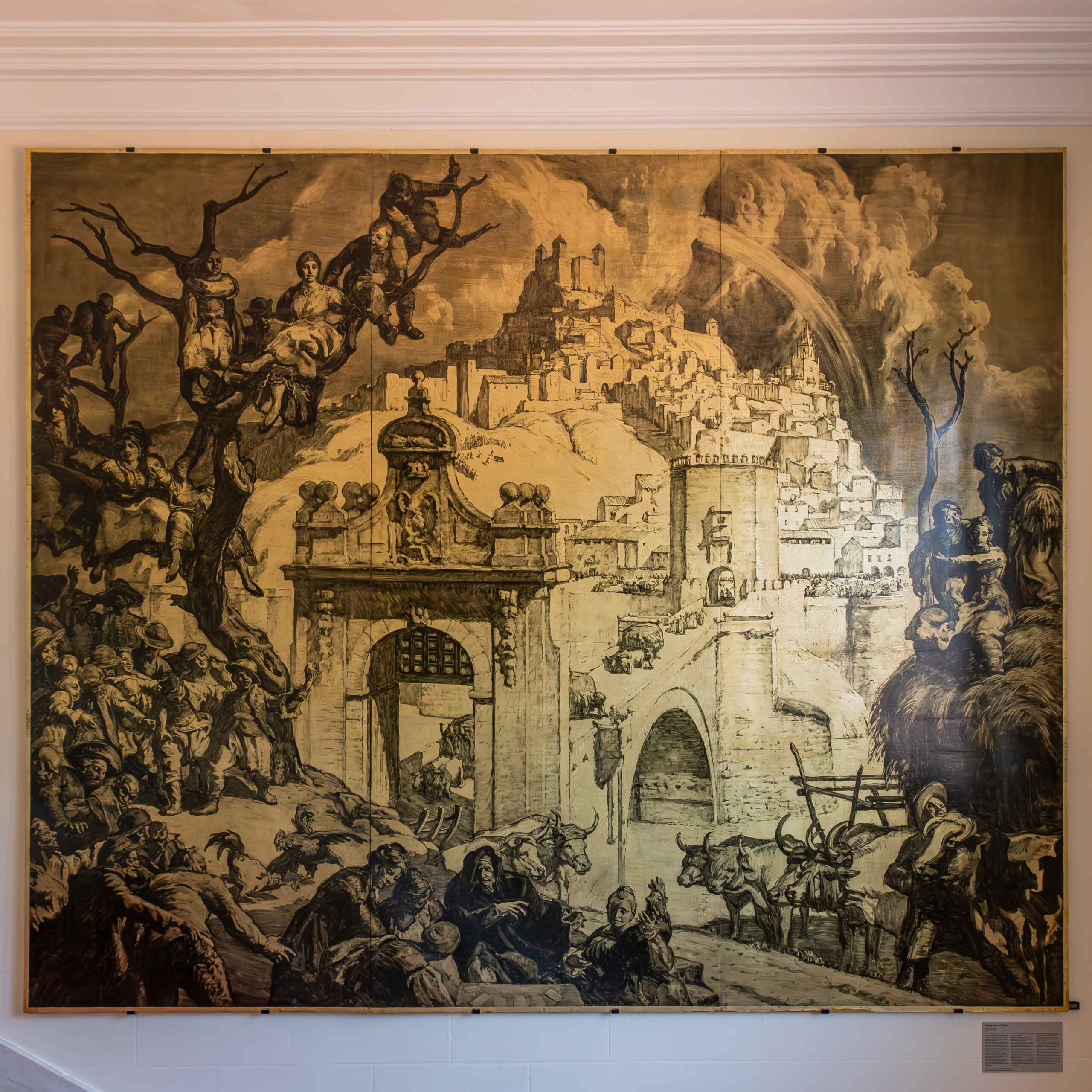
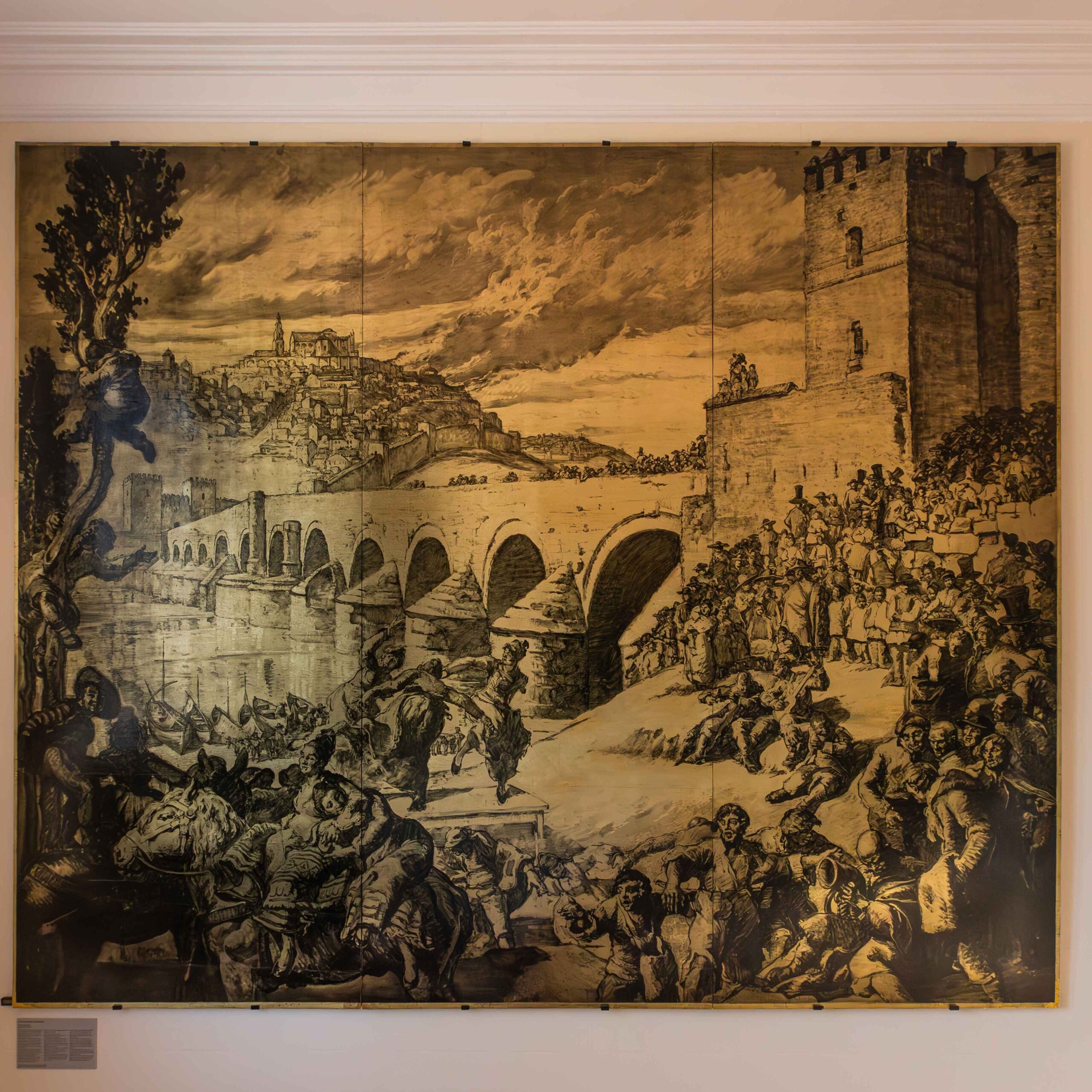
The relocation returned the murals to a more appropriate context, both geographically and within the building that houses them. They are once again located in a stair hall, the size and grandeur of the surrounding architecture a much better fit for the scale and style of the artwork than their former location in the entryway of the US Embassy in Madrid. The setting in Barcelona will also aid in the murals’ long-term preservation. A careful restoration, addressing condition issues stemming from fluctuations in climate and mounting hardware, was carried out as part of the relocation and their condition continues to be monitored on a regular basis. As the Consulate’s stair hall has a more stable environment and controlled light exposure, they remain in excellent condition in their new home.
Though the murals are not original to the US Consulate building, it provides a particularly appropriate setting for them. The Consulate is far more than a backdrop for these remarkable murals. A 1914 Noucentrist palace designed by the architect Enric Sagnier (1858–1931), the Consulate is listed on the Secretary of State’s Register of Culturally Significant Property. Sagnier, also a native of Barcelona, is known to have collaborated with Sert on other projects. The Office of Cultural Heritage is pleased to be able to display and preserve important works of two talented Catalonians in the region’s capital.
WHO WAS JOSEP MARIA SERT?
Josep Maria Sert (Catalan, 1874 – 1945) was born in Barcelona and studied art in Rome before establishing a studio in Paris at 25 years old. There, he became part of an artistic community of decorative artist and was soon one of the most sought-after muralists of his time, painting over 7000 square meters of private and public buildings around the world. Sert’s work for the Vic Cathedral in Spain (1906–1929) marked the shift in his practice from a colorful palette to his famed grisaille style shown in the murals of Toledo and Cordoba.

ABOUT U.S. CONSULATE BARCELONA
The Barcelona Consulate was built in 1914 as a residence for Mercedes and Gloria Godó, sisters and descendants of Bartolome Godó Pie, founder of the newspaper La Vanguardia. They commissioned Barcelona architect Enric Sagnier (1858–1931) to design their house, Torre Godó Eguia, in the city’s Sarria neighborhood. His style evolved over his lengthy practice in Barcelona and his commission for the Godó sisters’ home resonates as an example of his interpretation of the Noucentista in an eclectic manner by emphasizing volume, light, composition of the façade, smooth wall planes for applied decoration, and interior axial lines.
The first U.S. consulate in Barcelona opened in 1797 to foster commerce and cultural ties between the young American nation and the prosperous Catalonian region. After almost 200 years of important political and consular activity in the region, and several moves by the U.S. to various properties, the consulate was relocated to Torre Godó Equia in 1992; the same year the world turned its attention to Barcelona as the city hosted the XXV Summer Olympic Games.
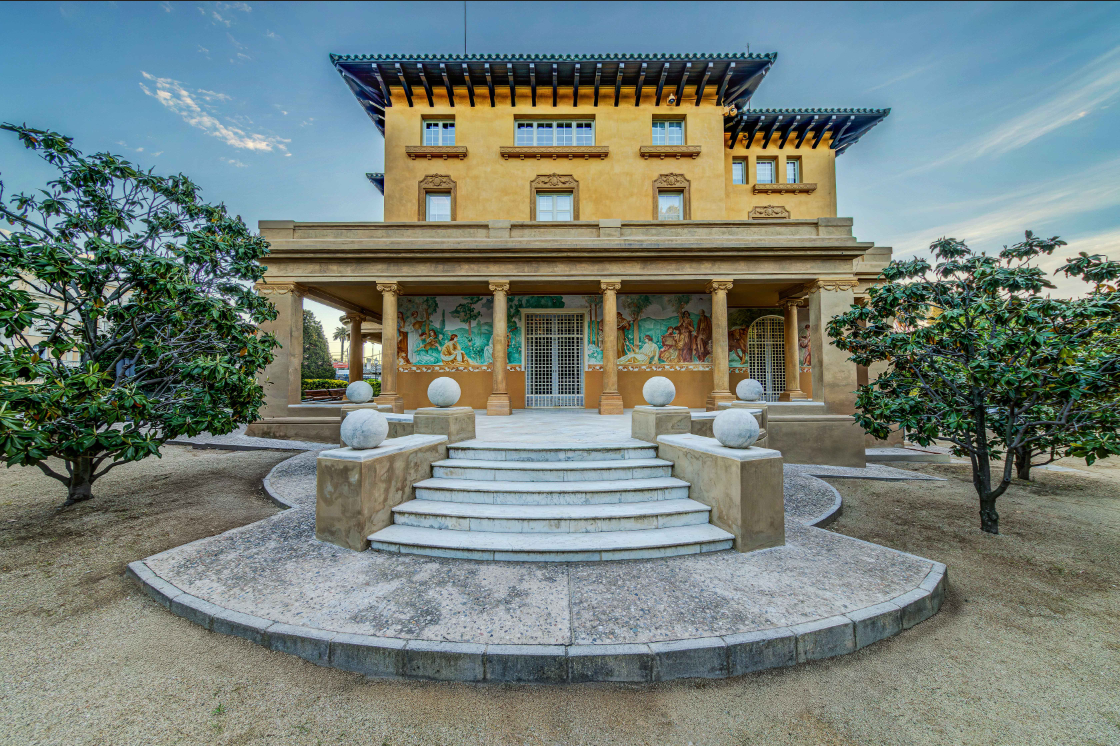
Although the property has been altered to better suit the needs of the consulate and serve as a diplomatic facility, Torre Godó Equia remains well preserved. A restoration of the façade of the consulate was completed in 2024, further cementing the State Department’s investment in nurturing cultural exchange with the people of Catalonia and of Spain.
PROPER CARE FOR CULTURAL HERITAGE ARTWORKS
Context
The Office of Cultural Heritage is charged with the care and preservation of significant artworks like these murals and structures like the U.S. Consulate in Barcelona. As part of this mission, the office strives not only to achieve but to lead in terms of best practices in the field of collections care. Partnering with a science writer and illustrator, CH has produced an illustrated manual to provide guidance on best practices for caring for collections. The manual addresses several factors that are pertinent to the murals’ condition and care, such as the impact of environment and movement and handling.
Environmental Factors
The environment an artwork is in can have a major impact on its condition over time. Fluctuations in temperature and humidity can be especially impactful for organic materials like the murals, painted on thin wood panels. Wood reacts to changes in humidity, its dimensions changing with more moisture in the air. Frequent fluctuations are more damaging than longer term seasonal shifts as, over time, the stress from repeated expansion and contraction causes cracks and losses, like those seen on the murals.
For the Sert murals, the previous location, in the entryway of the US Embassy in Madrid, was a particular challenge for maintaining a steady climate since the doors opened frequently as personnel entered and exited the building. The interior stair hall in Barcelona has an inherently more stable climate which will benefit the murals’ long-term preservation. Light exposure is another environmental factor that impacts artwork. Happily, Sert’s signature grisaille palette made the murals more robust than other more colorful artworks that can quickly show fading and light damage. However, light damage is cumulative and even hardier artworks can be affected, so the lower and more controllable light levels in their new location are another improvement to their circumstances.
Moving Objects
One of the most important times to protect artworks from damage is while moving them, either for short distances or longer ones. Even small moves require advance planning and careful consideration to determine the right personnel, protection, path, and destination – all of which is discussed in Chapter 3 of the Collections Care Manual focused on Handling, Moving, and Storage. However, in many cases and for big moves, professional art handlers are necessary to ensure the proper care and handling.
In this case, the distance, size of the murals, and their complex construction – each made of three large wooden panels joined by wood wafers – meant they needed professional handling, packing, and movement. A video produced by the U.S. Embassy Madrid and U.S. Consulate Barcelona shows the specialized equipment, packing, and careful handling that went into safely completing the move.